

Research
Patient-derived cancer stem cell culture
Normal organs consist of various cell types with different functions, such as nutrient absorption, metabolism, and hormone secretion. The cells responsible for producing these functional cells are called stem cells. Although cancer cells lose most functions of normal cells, a distinction still exists between stem cells and non-stem cells, and only stem cells (cancer stem cells) are believed to have the capacity for unlimited growth.
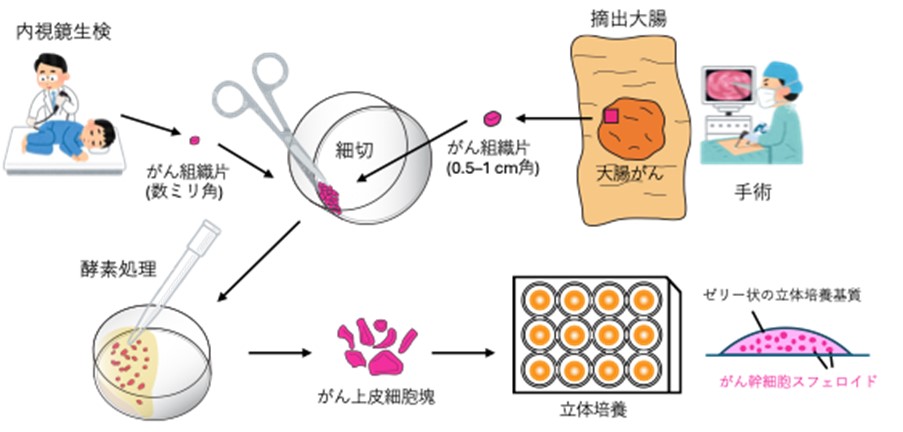
In recent years, techniques have been developed to isolate and culture live cancer stem cells in vitro from cancer tissue obtained by surgery or endoscopic biopsy, and various research studies are underway using this technology. Cancer cells grow within a gel-like matrix (culture matrix), forming a three-dimensional cell mass (an organoid or spheroid). Organoids consist of multiple cell types and develop complex structures within the gel that resemble those found in vivo. In contrast, spheroids are composed of a single cell type and have a spherical shape. Kyoto University, the leading institution behind this project, has been culturing colon and gastric cancer stem cell spheroids from surgically removed specimens since 2014 and has established cancer stem cell lines from over 200 colon cancer patients and more than 50 gastric cancer patients to date.
Development of new immunohistochemistry methods
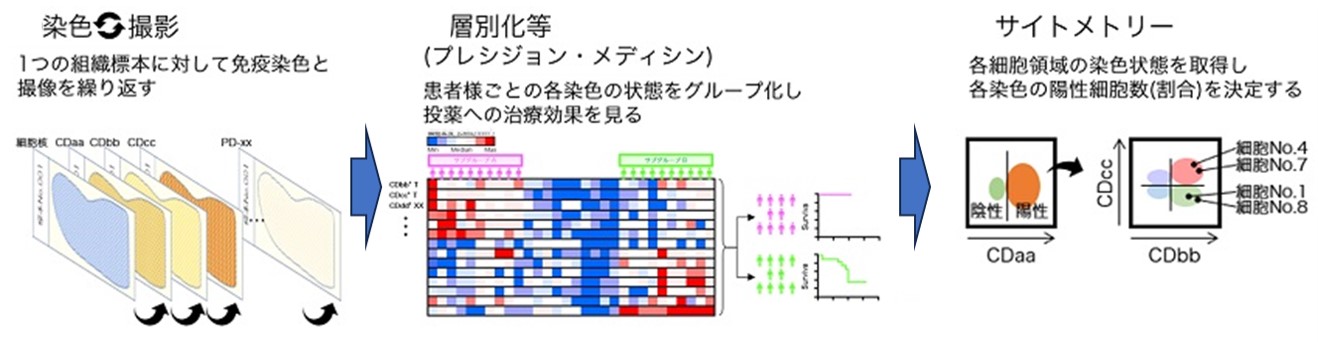
Aiming for personalized cancer treatment, we are developing technology for detailed analysis of cancer tissue obtained through diagnosis and therapy. This technology expands conventional immunohistochemistry by performing more than 12 types of immunostaining on a single tissue section, then imaging and analyzing it. It enables quantitative assessment of the number, properties, and distribution of cancer cells and immune cells, which relate to treatment effectiveness, and is expected to advance personalized medicine by helping to select the most suitable treatment for each patient.
“Personalized cancer therapy” using the patient’s own cancer cells
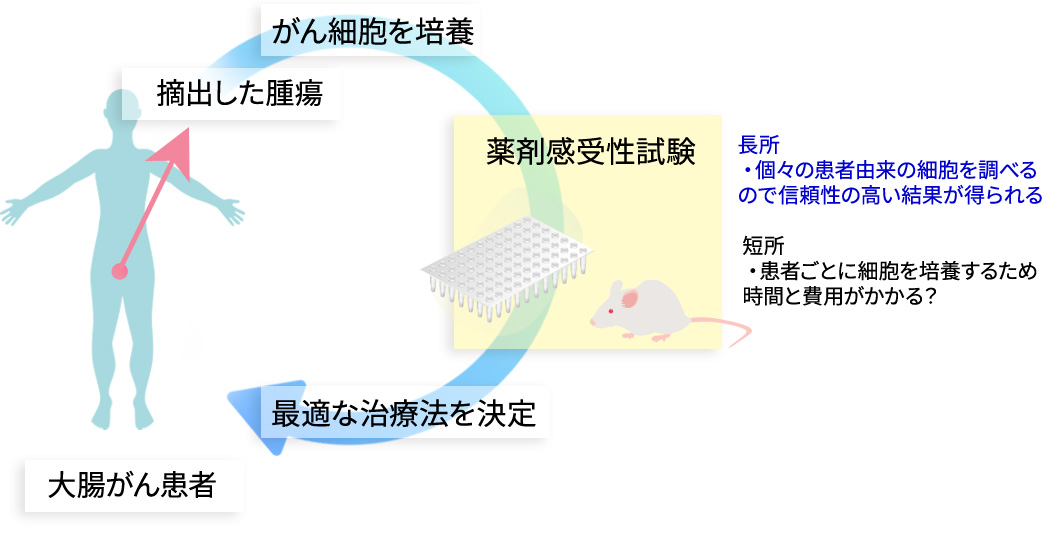
In recent years, cancer panel testing has been developed and is now covered by Japanese health insurance. It can analyze the cancer-related genes of a patient’s own cancer cells to select the appropriate anticancer drug for each type of cancer. However, fewer than 10% of patients ultimately receive treatment based on it. Meanwhile, drug sensitivity testing, which evaluates the effectiveness of anticancer drugs by culturing a patient’s own cancer cells in vitro, is expected to become a practical alternative to cancer panel testing, as it can predict drug effectiveness more directly than genetic testing. Nonetheless, to determine how accurately this method can predict efficacy in actual patients, clinical trials for each drug are necessary to thoroughly verify its precision. Additionally, concerns remain regarding the time and cost involved in culturing cells for each patient.
Advancing personalized cancer diagnosis through collaboration among industry, academia, and government
To provide personalized cancer diagnoses using a patient’s own cancer cells as a standard medical service at an affordable cost, it is crucial to develop simpler, lower-cost culture and measurement technologies. However, such research has not been actively pursued due to limited academic novelty for universities and the high risks for companies. Additionally, the diagnostic process involves various technical components, making it difficult for a single company to develop. Reliable clinical trials also require the participation of multiple hospitals and the collection of numerous cases. To address these challenges, we formed a consortium of multiple companies and academic institutions (universities, etc.) with support from the Innovative Medical Technology Research and Development Promotion Program (Industry-Academia-Government Collaboration) (AIMGAIN) managed by the Japan Agency for Medical Research and Development (AMED). This consortium (the “Consortium for the Development of Personalized Cancer Therapy”) aims to develop personalized cancer diagnosis using a patient’s own cells through collaborative research that leverages each partner’s expertise, ultimately improving patients’ quality of life (QOL).
Main research topics
- Verification of drug efficacy prediction accuracy through spheroid drug-sensitivity testing
- Development of methods for isolating and culturing circulating tumor cells
- Development of new three-dimensional culture matrix materials
- Development of diagnostics for predicting drug efficacy using multiple immunohistochemistry